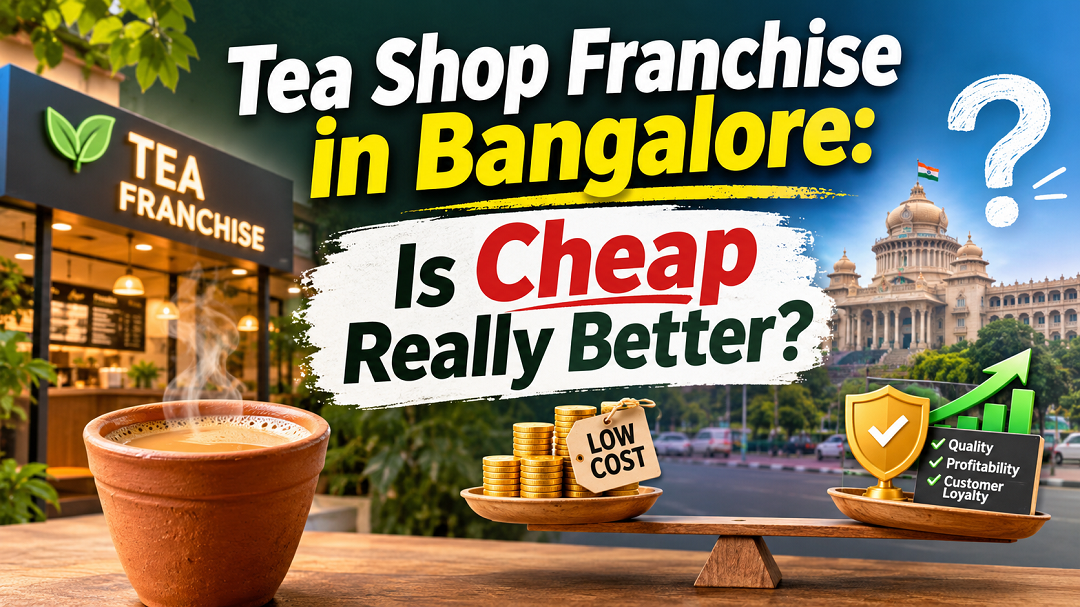
If your first question is “Which tea franchise is cheapest?”, you may be comparing the wrong number.
A low entry price is attractive. It makes business ownership feel possible, especially when you are planning your first outlet.
But the amount needed to open a shop does not explain what it takes to keep that shop running.
Rent continues after launch day. Staff need clear responsibilities. Ingredients must be purchased, prepared and controlled. Customers need a reason to return after their first visit.
If you are exploring a tea shop franchise in Bangalore, the more useful question is:
“What does this investment include, and can I operate this format well at my proposed location?”
That question may produce a less exciting conversation than a fast-return headline. It can also produce a much clearer business decision.
The Cheapest Franchise Can Still Be the Wrong Fit
Imagine comparing two hypothetical franchise offers.
One advertises a lower initial amount but leaves several setup tasks to the franchisee. Another has a higher quoted amount and includes more equipment, training and launch assistance.
You cannot meaningfully compare them until you understand the scope.
The lower-priced option might still suit you if you already have the space, equipment or operating experience. The more expensive option might be useful if its additional support addresses work you cannot handle yourself.
Neither price tells the whole story.
Before choosing, ask for a written breakdown separating:
- Franchise or brand-related fees.
- Equipment and installation.
- Interior work and signage.
- Initial stock and packaging.
- Training and opening support.
- Property-related expenses.
- Recurring charges.
- Items you must arrange independently.
A low price is useful only when you understand what you are buying.
“Opening Cost” and “Money Needed to Operate” Are Different
A shop can be ready to open while its owner is unprepared for the first few months of operation.
That distinction deserves more attention than it usually receives in a short franchise advertisement.
Depending on the proposal and property, your planning may need to account for a rental deposit, advance rent, utility setup, staff costs, replenishment stock and operating reserves.
Some expenses may be included in the franchise quotation. Others may not. Do not assume either way.
Use a simple comparison sheet:
| Cost category | Question to ask |
|---|---|
| Franchise package | What is included in the quoted amount? |
| Property | Who pays deposits, rent and property modifications? |
| Equipment | What is supplied, installed and covered by warranty? |
| Opening stock | What quantity is included, and when must it be replenished? |
| Staffing | What support is provided, and who pays ongoing wages? |
| Marketing | Which activities are included, and who pays advertising spend? |
| Operations | What recurring fees or purchase requirements apply? |
| Working capital | What funds will be available while sales develop? |
The purpose is not to make a tea business sound complicated. It is to make the commitment visible before you pay.
A Busy Road Does Not Automatically Mean a Busy Tea Shop
Bangalore offers many different trading environments. An office-facing outlet, a neighbourhood shop and a college-area counter may serve different customer routines.
The name of the neighbourhood cannot tell you how a particular shop will perform.
A property in Whitefield might sit near a useful pedestrian route—or behind an entrance that customers rarely use. A shop in Banaswadi might attract nearby regulars—or struggle because stopping is inconvenient.
Treat these as questions to investigate, not assumptions about either area.
Observe the exact property at the times you intend to trade.
Look for people who can realistically become customers:
- Can they see the shop?
- Can they reach it easily?
- Do they have time to stop?
- Are they buying refreshments nearby?
- Is the activity consistent across several days?
- Does the location depend on one office, institution or peak period?
Traffic passing your signboard is not the same as customers walking through your door.
For a closer look at this decision, use Tea Adda’s tea shop franchise location checklist alongside your site visits.
A Bigger Menu Can Create More Work Before It Creates More Sales
A long menu looks impressive in a brochure. It gives customers choice and may offer opportunities to sell snacks alongside beverages.
It also raises operational questions.
Each additional category can involve ingredients, storage, preparation, equipment and staff training. The right menu depends on what your customers want and what your team can consistently deliver.
Consider the difference between a customer collecting tea during a short office break and a group sitting down for a relaxed evening visit.
Their expectations are different. Your format should reflect that.
Before choosing a franchise, ask:
- Which items are central to the proposed format?
- Which can be prepared efficiently during peak periods?
- What ingredients are shared across products?
- How is stock monitored?
- How are unavailable items handled?
- Can the opening menu be planned around the approved format and local demand?
The question is not simply how many items appear on the menu. It is how well the outlet can serve the items customers actually order.
Sales Figures Are Not Take-Home Profit
A sales target can help frame a discussion, but it does not tell you what the owner will retain.
You still need to understand ingredients, packaging, rent, wages, utilities, wastage and other applicable costs.
For illustration, suppose a hypothetical outlet records ₹3 lakh in monthly sales.
That figure alone does not reveal whether the business is profitable. You would need the corresponding expenses, any financing obligations and the treatment of the owner’s working time.
Similarly, an advertised payback period should lead to questions:
- What investment amount is being recovered?
- Which costs are included in the calculation?
- What sales level is assumed?
- Does the estimate include the owner’s salary?
- What happens if sales develop more slowly?
- Is the figure based on comparable operating outlets or a forecast?
A projection becomes more useful when you can see its assumptions.
Ask the franchisor to explain the calculation in writing and distinguish estimates from contractual commitments.
“Full Support” Needs a Definition
Franchise support can be valuable. However, the phrase means little until you know what happens in practice.
Training, setup assistance, supplier coordination and marketing can each cover a wide range of activities.
Take staff training as an example.
Does support mean an opening-day demonstration? A structured training period? Written procedures? Assistance when a trained employee leaves?
The same questions apply to marketing. Creating promotional material is different from managing paid campaigns, and campaign management is different from paying the media budget.
Ask for specific answers:
| Support area | What to clarify |
|---|---|
| Site selection | Who assesses the property, and what is reviewed? |
| Store setup | Who manages the work and confirms completion? |
| Training | Who is trained, for how long, and in which tasks? |
| Staffing | What happens if a key employee leaves? |
| Supplies | How do ordering, availability and pricing work? |
| Marketing | What is delivered, and what requires additional spending? |
| Ongoing support | Who handles operational questions after launch? |
A stronger conversation replaces broad promises with clear responsibilities.
Franchise Ownership Does Not Remove the Need for Management
A familiar brand and established processes can provide a starting structure. Someone still needs to ensure the outlet follows that structure.
For an owner-operated franchise, decide who will monitor:
- Opening and closing routines.
- Product consistency.
- Stock availability.
- Hygiene and cleaning.
- Staff attendance.
- Billing and cash handling.
- Customer feedback.
- Equipment problems.
If you expect a manager to handle these tasks, include that role in your planning.
If you are considering a separately managed investment arrangement, clarify how that model differs from operating a franchise yourself. Ask who manages the outlet, what reporting you receive and what responsibilities remain yours.
Do not assume two different business arrangements work the same way simply because they appear under one brand.
Repeat Customers Matter After the Launch Excitement Ends
Opening offers, decorations and social posts can introduce a new outlet. They do not explain why someone should return the following week.
For a tea business, the reasons may be straightforward:
The tea tastes familiar. Service fits the customer’s break. The outlet is clean. Their usual item is available. The price feels appropriate for the experience.
These are practical operating standards you can review.
During visits to an existing outlet, observe the experience as a customer. Pay attention to ordering, waiting, cleanliness, product presentation and how questions are handled.
If the franchisor can arrange discussions with existing franchisees, ask about ordinary operating days as well as launch day.
Useful questions include:
- What took longer than expected?
- Which support proved most useful?
- What does the owner monitor daily?
- What would you clarify before opening another outlet?
Real operating detail is more informative than a general statement that business is “going well.”
Where Tea Adda Fits Into the Comparison
Tea Adda currently presents Express, Lounge and ProServe formats on its franchise page.
Its advertised Express model requires 100–200 square feet, while Lounge lists 300–500 square feet. ProServe is presented as a corporate format. These options give prospective partners different operating models to discuss rather than a single shop format.
Start with the customer and property before choosing between them.
A compact takeaway location may call for a different operating plan from a seated café. A corporate setting requires its own discussion about access, customer availability and service expectations.
Tea Adda also lists setup assistance, recipe training, staffing support, vendor support and marketing activities. Confirm which deliverables apply to your selected proposal and which expenses remain separate.
Use the Tea Adda franchise information page as the starting point for that conversation, then request a current written quotation.
Take These Questions to Your Franchise Meeting
Before committing to a tea shop franchise in Bangalore, prepare a brief describing your available budget, proposed property, intended opening hours and level of involvement.
Then ask:
- Which format suits this property and customer base?
- What does the quoted amount include and exclude?
- What additional funds should the operating plan account for?
- What recurring charges or sourcing conditions apply?
- What assumptions support the sales and payback estimates?
- Who is responsible for staffing, training and replacements?
- What support continues after opening?
- How will stock, expenses and sales be reviewed?
- Can I visit an operating outlet and discuss day-to-day requirements?
- What happens if the proposed property or opening schedule changes?
You do not need an impressive answer to every question. You need a clear one.
Frequently Asked Questions
Is a low-investment tea franchise always the better choice?
No. A lower initial quotation may suit your situation, but compare the included work, property requirements, recurring expenses and operating responsibilities before deciding.
How much money is needed beyond the advertised package?
That depends on the package, property and operating plan. Ask for a complete cost breakdown rather than adding a generic estimate to the advertised amount.
Is a popular Bangalore neighbourhood enough to make a location suitable?
No. Assess the exact property, customer access, relevant footfall, trading hours and occupancy cost. Two shops in the same neighbourhood can have very different conditions.
Does a franchise guarantee customers?
A franchise may provide branding, products, training and support. Customer demand and repeat visits still depend on the location, offer and day-to-day experience.
How should I compare Tea Adda’s formats?
Start with your proposed customers, available space, operating involvement and budget. Ask the team to explain the scope and requirements of the format being recommended.
Choose a Tea Business You Can Operate With Confidence
A low price can start the conversation. It should not finish it.
The better decision is a tea franchise whose format fits your location, whose costs you understand and whose support addresses your actual needs.
If you are exploring a tea shop franchise in Bangalore, speak with Tea Adda about your proposed area, available space and operating plan.
Explore Tea Adda’s franchise options and request a detailed discussion of the model, setup scope and quotation.
You can also call +91 99860 24067 to begin your enquiry.
Before asking “How cheaply can I open?”, ask “What will it take to run this well?”
