
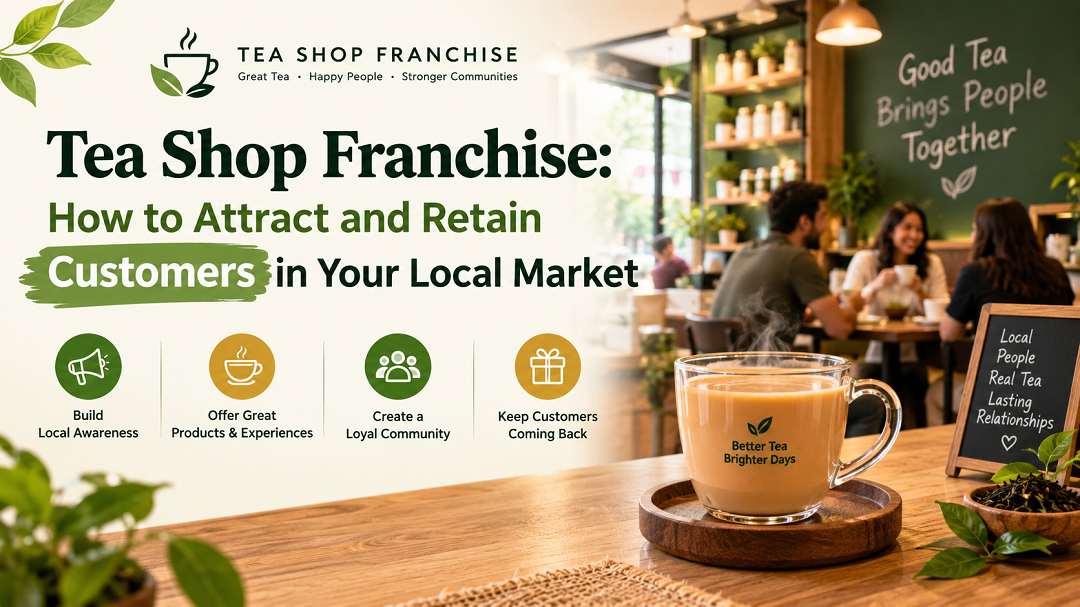
Starting a tea shop franchise is only the beginning of building a successful local food and beverage business.
The bigger challenge is creating a customer base that does not simply visit once, but keeps coming back.
A tea outlet can have an attractive interior, a large menu and a recognizable brand name, but long-term growth depends heavily on what happens after the first customer walks through the door.
Do customers enjoy the tea?
Is the service quick?
Is the outlet clean?
Can customers easily find the shop online?
Are the prices clear?
Is the experience consistent every time?
Do customers have a reason to return tomorrow?
These questions are particularly important for a modern tea business because tea is naturally suited to repeat consumption. A customer may visit before work, during an afternoon break, after college, while meeting friends or while ordering snacks in the evening.
For entrepreneurs considering a tea shop franchise, understanding how to attract local customers and convert them into regular customers can be just as important as understanding the initial investment.
This article explains practical strategies for building local visibility, improving customer experience, increasing repeat visits and creating a stronger tea-shop business.
Why Customer Retention Matters in a Tea Shop Business
A tea shop does not necessarily need every customer to be a new customer.
In fact, repeat customers can become an important part of a local outlet’s business.
Consider a customer who discovers a tea shop near their office.
They visit once.
If the experience is positive, they may return the following week.
Eventually, the outlet can become part of their daily or weekly routine.
This creates a completely different relationship between the business and the customer.
Instead of constantly spending effort trying to introduce the outlet to new people, the business can build a base of customers who already know the brand and products.
For a tea shop franchise, this can be especially valuable because franchise systems often provide standardized products, branding and operational processes that are intended to create a consistent experience across customer visits.
However, consistency must be delivered at the individual outlet level.
1. Start With the Right Local Market
Before thinking about Instagram posts or promotional offers, understand the people around the outlet.
A tea shop located near an office cluster may have a very different customer profile from one near a college, residential neighborhood or industrial area.
Potential customer groups can include:
- Office employees
- College students
- Local residents
- Shop owners
- Delivery workers
- Professionals
- Families
- Evening visitors
- Walk-in customers
- Takeaway customers
Understanding these groups helps determine the right menu, pricing, operating hours, promotions and communication style.
Example
An outlet near offices may receive strong demand during:
- Morning hours
- Tea breaks
- Lunch periods
- Evening office breaks
An outlet near colleges may experience stronger activity around:
- Morning college hours
- Afternoon breaks
- Evening hangouts
A residential outlet may have a different pattern, with customers ordering tea and snacks during morning and evening periods.
The location should therefore influence the marketing strategy.
2. Make Your Tea Shop Easy to Discover
A great tea shop cannot build a local customer base if people cannot find it.
For a new tea shop franchise, digital discoverability should be treated as part of the opening strategy.
Google Business Profile
A properly maintained Google Business Profile can help nearby customers discover:
- Business name
- Address
- Phone number
- Opening hours
- Photos
- Menu information
- Customer reviews
- Directions
Keep the information accurate and consistent.
Regularly add genuine photographs of the outlet, products and customer environment.
The objective is simple:
When someone searches for a tea shop nearby, your business should be easy to understand and easy to contact.
Local Search
Local SEO can also support discovery for searches such as:
- Tea shop near me
- Tea café near me
- Tea and snacks near me
- Tea shop in [area]
- Best tea café in [area]
- Chai and snacks in [area]
Do not create dozens of low-quality pages simply to target every neighborhood.
Instead, build useful local relevance around the actual outlet and the communities it serves.
3. Your Shopfront Is Your First Advertisement
Before a customer searches online, they may simply walk past your shop.
That makes physical visibility extremely important.
A good tea-shop storefront should communicate three things quickly:
What is this place?
What does it sell?
Why should I stop here?
Clear signage, visible branding and an attractive product presentation can help convert passing traffic into walk-ins.
For a franchise outlet, maintaining consistent branding can also help customers recognize the business across different locations.
4. Build a Menu That Encourages Repeat Visits
Tea may be the core product, but customers do not necessarily want exactly the same experience every time.
A well-planned menu can give customers reasons to explore additional products.
A modern tea café may offer combinations such as:
Tea
- Masala tea
- Ginger tea
- Cardamom tea
- Lemon tea
- Black tea
- Green tea
- Herbal beverages
- Iced tea
Snacks
- Maggi
- Sandwiches
- Puffs
- Rolls
- Samosas
- Quick bites
Other Beverages
- Coffee
- Coolers
- Shakes
- Flavoured beverages
The objective is not simply to create the longest possible menu.
The objective is to create a menu that makes sense for the target customers and outlet format.
Too much complexity can slow preparation and increase operational challenges.
A balanced menu can give customers variety while keeping the service process manageable.
5. Create Signature Products
A customer may remember a tea shop because of its name.
But they may return because of a particular product.
This is where signature products can become valuable.
For example, a tea brand may develop recognizable combinations around:
- Signature chai
- Special masala tea
- Flavoured tea
- Iced tea
- Tea and snack combos
- Café-style beverages
A signature product gives customers something specific to talk about and recommend.
Instead of saying:
“There is a tea shop near my office.”
A customer can say:
“You should try their special chai.”
That difference can help word-of-mouth marketing.
6. Consistency Is More Important Than One-Time Promotions
One of the biggest challenges in the food business is consistency.
Imagine a customer visits on Monday and enjoys a particular tea.
They return on Friday.
The taste is completely different.
The second experience can damage the trust created by the first.
For a tea shop franchise, standardized recipes, preparation methods, ingredient specifications and staff training can help maintain consistency.
Tea Adda’s current franchise model describes recipe training, hygiene guidance, trained chef support, operational manuals, staff training and vendor/raw-material support among its franchise support areas.
The principle is simple:
The customer should know what to expect every time they visit.
7. Speed Matters in a Tea Business
Tea is often purchased during a limited break.
A customer may have only 10 or 15 minutes.
If ordering takes too long, preparation is slow or billing becomes complicated, the customer experience suffers.
A tea outlet should therefore focus on:
- Efficient ordering
- Clear menu display
- Fast preparation
- Organized counter operations
- Simple payment
- Proper staff coordination
- Quick takeaway service
Technology can also help with ordering and billing.
The faster the basic customer journey becomes, the easier it is to serve more customers during busy periods without sacrificing service quality.
8. Create a Comfortable Customer Experience
Modern tea cafés are not necessarily competing only on beverages.
They can also compete on experience.
Customers may visit a tea café to:
- Meet friends
- Take a break
- Work casually
- Have a conversation
- Spend time after college
- Relax after work
- Enjoy snacks with tea
That means factors such as:
- Cleanliness
- Seating
- Lighting
- Music
- Temperature
- Staff behavior
- Table cleanliness
- Packaging
- Overall ambience
can influence how customers perceive the outlet.
A small outlet does not need expensive interiors to create a positive experience.
Even a compact tea shop can feel welcoming when the space is clean, organized and comfortable.
9. Turn First-Time Visitors Into Regular Customers
Getting a new customer is only the first step.
The next question is:
What gives them a reason to come back?
Several simple approaches can help.
Loyalty Programs
A simple loyalty system can encourage repeat purchases.
For example:
- Buy several beverages and receive a reward
- Digital loyalty points
- Member-only offers
- Repeat-customer discounts
- Combo benefits
The exact structure should be financially sustainable for the outlet.
Personalized Offers
If a customer regularly purchases tea and snacks, relevant offers may be more useful than generic discounts.
Visit-Based Rewards
Instead of focusing only on the value of one transaction, encourage customers to return multiple times.
The objective is to build a habit rather than generate one unusually large order.
10. Use Social Media as a Local Customer Channel
Social media should not simply be a place to upload posters.
A tea shop has many opportunities for visual and short-form content.
Content ideas include:
Product Videos
Show:
- Tea preparation
- Steam rising from hot chai
- Fresh snacks
- Pouring tea
- Cheese Maggi preparation
- Iced beverages
Behind-the-Scenes Content
Show customers how the outlet operates.
Examples:
- Morning preparation
- Fresh ingredients
- Staff preparation
- New menu launches
- Store setup
- Hygiene practices
Customer Moments
With appropriate permission, customer-focused content can show the atmosphere of the outlet.
Local Content
Connect the outlet with the surrounding neighborhood.
For example:
- Local events
- College-area content
- Office-area tea breaks
- Weekend moments
- Nearby community activities
This can make the social account feel local rather than like a generic corporate page.
11. Use Short Videos to Increase Local Awareness
Short-form video can be particularly useful for food and beverage businesses.
A simple 10–20 second video can show:
Problem → Tea → First Sip → Mood Change
Or:
Busy Day → Tea Break → Snacks → Relaxed Moment
The content does not always need complicated production.
Authentic product shots can sometimes be more useful than highly polished advertisements.
For a tea franchise outlet, consistent short-form content can gradually build recognition among people living and working nearby.
12. Encourage Genuine Customer Reviews
Reviews can influence how potential customers evaluate a local business.
After a positive experience, customers can be encouraged to leave an honest review.
Do not manufacture reviews or create fake customer experiences.
Instead, make the review process easy.
For example:
A QR code near the billing counter can direct customers to the appropriate review destination.
Staff can politely ask satisfied customers for feedback without pressuring them.
The goal should be to build a genuine collection of customer experiences.
13. Respond to Reviews Professionally
Getting reviews is not enough.
The business should also pay attention to feedback.
Positive reviews can be acknowledged with a simple thank-you.
Negative reviews should be handled professionally.
A useful response can:
- Acknowledge the customer’s experience.
- Avoid arguing publicly.
- Explain that the concern is being reviewed.
- Offer an appropriate way to continue the conversation.
Customer feedback can also reveal operational problems.
If multiple customers mention slow service, that may indicate a process problem.
If customers repeatedly mention a particular product, that can reveal a menu opportunity.
Reviews can therefore function as a source of operational feedback.
14. Use Offers Strategically Instead of Discounting Everything
Discounts can attract attention, but constant discounting can train customers to wait for offers.
Instead, consider targeted promotions.
Examples:
Morning Combo
Tea + snack
Evening Combo
Tea + quick bite
Student Offer
Selected products during specific hours
Office Break Combo
Tea + snack for nearby employees
Weekend Combo
Beverage + snack combination
The promotion should match the customer segment and time of day.
15. Partner With Nearby Businesses
A tea shop can build local relationships beyond individual customers.
Potential partnerships include:
- Offices
- Co-working spaces
- Colleges
- Gyms
- Hostels
- Retail stores
- Salons
- Local events
- Corporate offices
For example, an office nearby may require tea and snacks for meetings.
A local event may need bulk beverage service.
A tea outlet can therefore develop both individual retail customers and business customers.
16. Corporate and Bulk Orders Can Create Another Revenue Channel
A tea business does not have to depend entirely on walk-in customers.
Corporate meetings, office events, workshops, seminars and local functions may require beverages and snacks in larger quantities.
A franchise outlet can explore:
- Office tea orders
- Meeting refreshments
- Event beverages
- Bulk snack orders
- Corporate packages
Tea Adda also promotes corporate-focused service through its ProServe franchise model, which is designed around corporate/MNC audiences.
This creates an opportunity to build relationships with businesses located near the outlet.
17. Delivery Can Extend the Local Customer Base
A physical tea shop can serve customers beyond its immediate walk-in traffic.
Depending on the location and available platforms, delivery can help reach:
- Nearby offices
- Residential customers
- Students
- Hostels
- Small businesses
- Customers ordering for groups
The key is to make delivery-friendly products and packaging part of the operating plan.
Tea and snacks should reach the customer in an acceptable condition.
18. Measure What Customers Actually Buy
A successful tea shop should not rely entirely on assumptions.
Track basic business data such as:
- Daily orders
- Average order value
- Best-selling tea
- Best-selling snack
- Peak hours
- Slow hours
- Repeat customers
- Delivery orders
- Combo sales
- Promotional performance
Suppose one snack consistently sells with a particular tea.
That information can be used to create a combo.
Suppose sales are weak between 3 PM and 5 PM.
That period may be suitable for a targeted offer.
Data can therefore help turn marketing from guesswork into an ongoing improvement process.
19. Understand Your Peak Hours
Every outlet has its own customer rhythm.
A tea shop near an office may have:
Morning → Breakfast/tea traffic
Midday → Lunch/refreshment traffic
Evening → Tea and snack traffic
A residential outlet may have stronger morning and evening demand.
A college-area outlet may have different peak periods.
Understanding these patterns helps with:
- Staff scheduling
- Inventory planning
- Promotions
- Product preparation
- Marketing timing
A tea shop franchise should be managed according to its local market rather than assuming every outlet behaves identically.
20. Build a Community Around the Outlet
A strong tea café can become more than a place where people buy beverages.
It can become a familiar local meeting point.
Simple community activities can help create this identity:
- Student meetups
- Small local events
- Quiz evenings
- Sports screenings
- Festive promotions
- Community collaborations
- Local creator meetups
The idea is not to organize expensive events every week.
Even small activities can make an outlet feel connected to its neighborhood.
21. Why Franchise Support Can Matter
Building all these systems independently can be challenging for a first-time entrepreneur.
This is one reason people consider a tea shop franchise instead of starting completely from scratch.
Depending on the franchisor and agreement, franchise support may cover:
- Brand identity
- Store design
- Menu development
- Recipes
- Training
- Staff support
- Equipment
- Vendor relationships
- Marketing
- Launch activities
- Operational SOPs
- Technology
The exact support varies between brands and should always be confirmed in writing before investing.
Tea Adda’s current franchise offering describes support covering store setup, POS, kitchen equipment, staff training, raw-material assistance, marketing, location guidance and operational support.
22. What Should Entrepreneurs Look for in a Tea Shop Franchise?
If you are researching a tea franchise opportunity, look beyond the headline investment number.
Consider:
Brand
Is the concept clearly positioned?
Menu
Does the menu suit the intended customer?
Location Support
Does the franchisor provide guidance on selecting an outlet?
Training
What training is provided to the franchisee and staff?
Operations
Are there clear SOPs for preparation, hygiene and service?
Marketing
What marketing assistance is actually included?
Supply Chain
How are ingredients and packaging sourced?
Technology
Does the system support billing, ordering and reporting?
Agreement
What are the franchise duration, fees, renewal conditions and other commercial terms?
Financial Information
Are sales and ROI figures clearly identified as projections or historical/indicative figures rather than guaranteed outcomes?
These questions can help entrepreneurs compare opportunities more carefully.
23. A Local Customer Growth Framework for a New Tea Shop
A practical customer-growth strategy can be divided into four stages.
Stage 1: Get Discovered
Focus on:
- Google Business Profile
- Storefront visibility
- Local SEO
- Social media
- Local listings
- Launch promotion
Stage 2: Create a Good First Experience
Focus on:
- Taste
- Hygiene
- Speed
- Pricing
- Staff behavior
- Store atmosphere
Stage 3: Encourage the Second Visit
Focus on:
- Loyalty
- Combos
- Relevant offers
- Signature products
- Customer engagement
Stage 4: Build Regular Customers
Focus on:
- Consistency
- Community
- Reviews
- Personalized communication
- Corporate relationships
- Local partnerships
This creates a customer journey rather than relying on one-time advertising.
24. The Most Important Formula: Visibility + Experience + Consistency
A local tea shop needs more than marketing.
Think of growth as three connected elements:
Visibility
People need to discover the outlet.
↓
Experience
They need a reason to enjoy the visit.
↓
Consistency
They need a reason to return.
If one element is missing, growth can become difficult.
Strong advertising cannot permanently compensate for poor service.
Excellent tea cannot help enough people if nobody knows where the outlet is.
And a great first visit may not produce long-term loyalty if the next visit is inconsistent.
The strongest local tea businesses work on all three.
Tea Shop Franchise: Frequently Asked Questions
How can a tea shop franchise attract more local customers?
A tea shop franchise can use local search visibility, Google Business Profile optimization, social media, storefront branding, local partnerships, targeted promotions, customer reviews and a consistent product experience.
How can a tea shop increase repeat customers?
Focus on consistent taste, quick service, cleanliness, customer-friendly staff, loyalty programs, useful combinations, signature products and a comfortable experience.
Is social media important for a tea shop franchise?
Yes. Social media can help showcase products, introduce the outlet to local audiences, promote offers and create awareness around the customer experience.
How important is location for a tea shop?
Location can strongly influence customer access and sales potential. Before selecting a property, entrepreneurs should evaluate visibility, pedestrian movement, nearby offices or residences, competition, rent, parking and delivery access.
Should a tea shop offer snacks along with tea?
A tea-and-snacks model can provide customers with more choices and create opportunities for combination orders. The menu should still be designed around the local market and operational capacity.
How can a tea shop get genuine customer reviews?
After a positive experience, businesses can politely invite customers to leave honest feedback through their preferred review platform. The business should not create fake reviews or manipulate ratings.
Can a tea shop franchise serve corporate customers?
Yes. Depending on the business model, tea outlets can explore office tea orders, meetings, events, workshops and bulk beverage or snack requirements.
What makes customers return to a tea shop?
There is no single factor. Taste consistency, service speed, cleanliness, pricing, convenience, product variety and overall experience can all influence repeat visits.
Does a tea franchise guarantee success?
No business should be treated as automatically successful. Actual results can vary depending on location, rent, sales, operating costs, competition, management and customer demand.
Final Thoughts: Build Customers, Not Just Transactions
A tea shop franchise should not be viewed simply as a place where tea is sold.
A successful local outlet can become part of people’s everyday routines.
The morning cup before work.
The evening tea with friends.
The quick snack during a break.
The conversation after college.
The office meeting order.
The weekend catch-up.
These repeated moments can create something much more valuable than a single transaction: customer habit.
For entrepreneurs entering the tea business, the long-term objective should therefore be to build a local brand that customers recognize, trust and want to revisit.
Start with the right location.
Offer consistent products.
Keep service efficient.
Make the outlet welcoming.
Build digital visibility.
Listen to customer feedback.
Use local marketing.
Create reasons to return.
And continuously improve the customer experience.
Explore Tea Adda Tea Shop Franchise Opportunities in Bengaluru
If you are looking to turn these ideas into a real tea business, Tea Adda offers multiple franchise formats designed for different outlet sizes and customer environments.
The current Tea Adda franchise models include:
Tea Adda Express – Outlet Model
- Investment: ₹4–₹5 lakhs
- Suggested space: 100–200 sq. ft.
- 100+ customized menu items
- Tea, coolers, Maggi and quick snacks
- Trained chef support
Tea Adda Lounge – Café Model
- Investment: ₹5–₹6 lakhs
- Suggested space: 300–500 sq. ft.
- 140+ menu items
- Beverages, snacks, shakes and light meals
- Trained chef support
Tea Adda ProServe – Corporate Model
- Investment: ₹7–₹10 lakhs
- Designed for corporate/MNC environments
- Tailored menu options
- Trained chef support
These are the currently published Tea Adda model details; prospective franchisees should confirm the latest pricing, commercial terms, support and financial assumptions directly with Tea Adda before making an investment.
Tea Adda also describes support covering store setup, staff training, recipes and hygiene, vendor/raw-material support, marketing, location guidance, POS and operational assistance.
Ready to Explore a Tea Shop Franchise in Bengaluru?
If you are serious about starting a tea business and want to explore Tea Adda’s current franchise models, investment requirements, outlet formats and support system, visit the dedicated franchise page:
Tea Adda Tea Shop Franchise in Bengaluru
Explore the available models, check the space and investment requirements, and contact the Tea Adda team to discuss your proposed location and business requirements.
Your tea business starts with a cup—but long-term growth starts with customers who choose to come back.
