
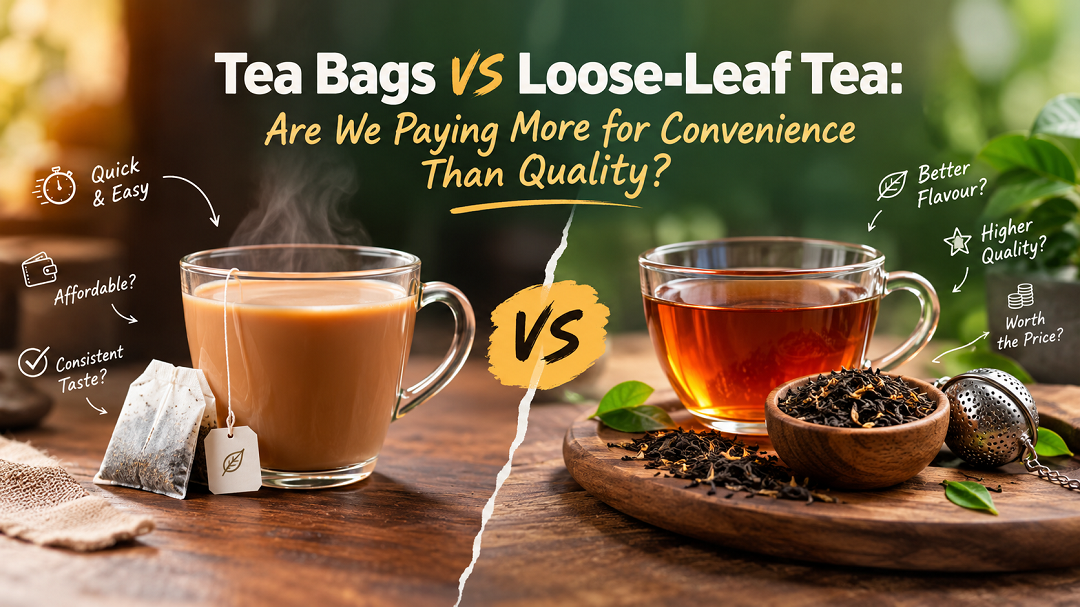
Is your premium cup of tea genuinely better, or are you paying extra for packaging, branding, and convenience? This question is dividing tea lovers, health-conscious consumers, and premium beverage brands.
Tea bags promise speed and simplicity. Loose-leaf tea promises a more traditional brewing experience, greater control, and the opportunity to explore different flavours. But when you compare what is actually inside the cup, the debate becomes more complicated than many people realise.
Some consumers believe loose-leaf tea is always superior. Others argue that a good tea bag can deliver excellent flavour without the extra equipment or preparation.
So, are tea bags an overpriced shortcut, or is loose-leaf tea an overrated luxury?
Let’s examine the facts, challenge some common assumptions, and find out what consumers should really look for before buying their next pack of tea.
1. The First Controversy: Are You Paying for Tea or Convenience?
Imagine two people preparing their morning tea.
The first person opens a tea bag, places it in a cup, adds hot water, waits a few minutes, and gets on with the day.
The second person measures loose tea leaves, heats the water, uses an infuser or strainer, and adjusts the brewing time to achieve the flavour they prefer.
Both get a cup of tea. Yet their shopping choices, preparation methods, and expectations may be very different.
Tea bags are designed to make preparation easier and more consistent. Loose-leaf tea offers greater flexibility over the amount of tea used, brewing strength, and extraction time.
Here is the uncomfortable question: when you buy premium tea, are you paying for better tea or simply a better experience?
The answer depends on the product. Some tea bags contain excellent tea leaves, while some loose-leaf products may disappoint despite their premium packaging.
Convenience has genuine value. But convenience alone does not prove superior quality.
2. The Tea Bag Myth: Does Smaller Tea Mean Inferior Tea?
One of the biggest arguments in the tea industry concerns the size of the tea particles inside a tea bag.
Many tea bags contain smaller tea particles, including broken leaves and tea fannings. These can release flavour and colour quickly, making them suitable for a short brewing time.
Loose-leaf tea often contains larger pieces of leaf, particularly in premium whole-leaf products. These leaves may release their flavour more gradually and offer a different brewing experience.
But there is an important distinction that consumers should understand.
Smaller tea particles do not automatically mean poor-quality tea.
Tea grading, leaf size, aroma, freshness, growing conditions, processing, and storage all influence the final cup. Smaller particles can produce a strong, satisfying brew, while poorly stored whole leaves may taste stale or flat.
The real question is not simply whether the tea is broken or whole. It is whether the tea delivers the flavour, aroma, and quality you expect at its price.
The next time you see the words “premium whole leaf” on a packet, ask yourself: is the product worth the premium, or is the label doing most of the selling?
3. The Price Debate: Is Loose-Leaf Tea Really More Expensive?
At first glance, loose-leaf tea can appear more expensive than ordinary tea bags. Premium loose-leaf products may also carry a much higher price per kilogram.
However, the packet price alone does not tell you how much each cup costs.
To compare fairly, consider:
- The price of the product per gram.
- How many grams are needed for one cup.
- Whether the tea can be brewed more than once to produce a satisfying cup.
- How much tea is wasted during preparation.
- Whether you need to purchase additional equipment.
For example, consider this hypothetical comparison:
| Cost factor | Tea bags | Loose-leaf tea |
|---|---|---|
| Product price | ₹150 for 100 bags | ₹300 for 100 g |
| Assumed amount per cup | 1 bag | 2 g |
| Approximate cups | 100 | 50 |
| Cost per cup | ₹1.50 | ₹6.00 |
In this example, loose-leaf tea costs four times as much per cup. These are illustrative prices, not current market averages, and the comparison assumes one bag per cup and 2 grams of loose tea per serving.
But does the more expensive cup taste better?
That is the question consumers should ask. A higher price may reflect better ingredients, sourcing, processing, packaging, or brand positioning. It does not, by itself, guarantee a better drinking experience.
The fairest comparison uses the same type of tea, similar brewing conditions, and a consistent serving size.
A premium label is not proof of premium value.
4. The Packaging Controversy: Could Your Tea Bag Be Part of the Problem?
This is where the discussion becomes particularly important.
Not every tea bag is made from the same material. Depending on the product, tea bags may use paper, plant-based fibres, plastic fibres, or combinations of materials. Some also use heat-sealing materials to maintain their shape.
Certain plastic-containing tea bags have attracted scientific attention because studies have investigated the release of micro- and nanoplastic particles under brewing conditions.
However, this does not mean every tea bag releases the same amount of particles, or that every tea bag poses the same risk. Results depend on the materials, manufacturing process, test conditions, and other factors.
Consumers who want to reduce unnecessary plastic exposure can take a practical approach:
- Check the manufacturer’s information about tea-bag materials.
- Look for clear, verifiable claims about plastic-free construction.
- Remember that “plant-based” does not automatically mean home-compostable.
- Check whether the product’s compostability claims are supported by relevant certification.
- Consider loose-leaf tea with a reusable stainless-steel infuser if you want to avoid disposable tea bags.
Loose-leaf tea is not automatically more sustainable in every situation. Packaging, transport, preparation, and waste also matter.
The controversy is not that all tea bags are dangerous. It is that consumers deserve transparent information about what they are buying and what happens to the packaging after use.
5. Does Loose-Leaf Tea Actually Taste Better?
For many tea enthusiasts, flavour is the strongest argument in favour of loose-leaf tea.
Larger leaves can provide a different extraction pattern, and loose tea gives drinkers greater control over the quantity used and the brewing process.
Depending on the tea, this may allow drinkers to explore more subtle aromas, floral notes, maltiness, astringency, and other flavour characteristics.
But tea bags have an advantage of their own: convenience and repeatability.
A well-made tea bag can deliver a pleasant, consistent cup. Meanwhile, loose-leaf tea can taste disappointing if it is stale, poorly stored, measured incorrectly, or brewed with unsuitable water.
The final flavour depends on several factors:
- The type and quality of the tea.
- The freshness and storage conditions.
- Water temperature.
- Brewing time.
- The amount of tea used.
- Whether milk, sugar, lemon, or other ingredients are added.
There is no universal winner.
For a fair test, prepare tea bags and loose-leaf tea of a comparable style under similar conditions. Taste them without revealing which is which, then compare aroma, flavour, strength, aftertaste, and overall preference.
You might discover that the more expensive option is your favourite. You might also discover that you prefer the less expensive one.
Either result is more useful than judging a tea by its packaging.
6. The Health Question: Is Loose-Leaf Tea Healthier?
The health debate is another area where marketing can get ahead of the evidence.
Tea naturally contains compounds such as polyphenols, and many varieties also contain caffeine. The amounts present in the finished drink depend on the tea, processing, serving size, and brewing method.
It is tempting to assume that loose-leaf tea must contain more beneficial compounds because it often looks less processed or more premium.
That conclusion is too simplistic.
Tea bags and loose-leaf tea can both contain valuable tea compounds. Their actual composition varies by product, and leaf size alone does not establish which cup is healthier.
Likewise, claims that a particular tea detoxifies the body, guarantees weight loss, or prevents disease should be treated cautiously unless supported by credible scientific evidence.
For everyday tea drinkers, practical considerations matter:
- Choose products from sources that provide reliable information about their ingredients.
- Store tea properly to preserve its quality.
- Pay attention to caffeine if you are sensitive to it.
- Consider how much sugar or sweetened milk you add.
- Avoid assuming that a premium price guarantees extra health benefits.
The biggest health difference in your daily cup may not be whether the tea comes in a bag or loose. It may be how you prepare and consume it.
7. The Marketing Trick: Are We Buying an Experience Instead of a Better Product?
Premium tea packaging often uses words such as “artisan,” “exclusive,” “handpicked,” “single origin,” and “luxury.”
These terms can communicate genuine product characteristics. But their presence on a packet does not automatically prove that the tea tastes better or offers better value.
A beautiful tin, elegant label, or premium-looking box can make a product feel more desirable before the first sip.
That is not necessarily dishonest. Packaging, design, and convenience are legitimate parts of a consumer product. The problem arises when presentation replaces meaningful information about the tea itself.
Before paying more, ask:
- Does the brand identify the tea type and origin?
- Are the ingredients clearly listed?
- Is the product fresh and properly sealed?
- Are quality claims specific and verifiable?
- Does the flavour justify the price?
- Is the cost reasonable compared with similar products?
The smartest consumer is not necessarily the one who buys the cheapest tea or the most expensive tea.
It is the person who understands what they are paying for.
8. Tea Bags vs Loose-Leaf Tea: Which One Should You Choose?
The best choice depends on your priorities.
Choose tea bags if you:
- Want tea that is quick and easy to prepare.
- Need a convenient option for the office, travel, or busy mornings.
- Prefer consistent portions with minimal cleanup.
- Find a particular tea-bag product that delivers the flavour you enjoy.
Choose loose-leaf tea if you:
- Enjoy experimenting with brewing strength and flavour.
- Want more control over the amount of tea used.
- Like exploring different tea origins and styles.
- Prefer using a reusable infuser instead of disposable tea bags.
Choose based on quality and value, not status.
A good tea bag can be better value than an expensive loose-leaf product. Equally, a well-sourced loose-leaf tea may offer a richer experience that justifies its price.
There is no need to turn a personal preference into a universal rule.
9. The Ultimate Tea Challenge: Try This Before Your Next Purchase
Want to settle the debate for yourself?
Conduct a simple blind taste test at home.
Step 1: Choose a tea bag and a loose-leaf tea of a similar type, ideally from comparable price ranges.
Step 2: Follow the recommended brewing instructions for each product, using measured quantities and suitable water temperatures.
Step 3: Taste both without looking at their packaging or knowing which is which.
Step 4: Score each cup for aroma, flavour, strength, aftertaste, and overall enjoyment.
Step 5: Compare the actual cost per cup and decide whether the difference in experience justifies the difference in price.
If you prefer the tea bag, there is no reason to feel that you are missing out. If you prefer loose-leaf tea, the additional preparation may be worthwhile.
The point is to make an informed decision instead of relying on marketing claims or assumptions.
10. Beyond the Cup: Why India’s Tea Culture Creates Business Opportunities
India’s relationship with tea goes far beyond a morning beverage. From roadside chai stalls to modern tea cafés, tea is part of everyday routines, social conversations, office breaks, and local business culture.
Consumers have different preferences. Some enjoy traditional milk tea, others prefer premium loose-leaf varieties, and many simply want an affordable, satisfying cup served quickly.
For entrepreneurs, this creates an interesting question: Can a tea business succeed by offering the right combination of taste, convenience, experience, and value?
The answer depends on more than the type of tea served.
A tea outlet also needs to consider its location, customer demand, pricing, operating costs, menu, service quality, and ability to build repeat business. Premium ingredients alone cannot guarantee success, just as a low-priced menu does not automatically produce strong profits.
For aspiring business owners, understanding what customers value is an important first step towards building a sustainable tea business.
Thinking of Starting Your Own Tea Business?
If India’s tea culture has inspired you to explore the business side of this everyday favourite, Tea Adda offers tea shop franchise opportunities in Bengaluru.
Through its franchise models, Tea Adda provides options for entrepreneurs interested in opening a tea outlet or a café-style business, with support that includes setup, menu planning, training, and operations.
Explore the available models, investment details, and franchise information directly on our website before deciding whether the opportunity suits your goals.
Interested in owning a tea shop in Bengaluru?
Visit Tea Adda’s Tea Shop Franchise in Bangalore page to learn more about the available franchise options and take the next step towards exploring your own tea business.
Final Verdict: Is Loose-Leaf Tea Worth the Extra Money?
Tea bags are not automatically inferior, and loose-leaf tea is not automatically superior.
Tea bags offer convenience, easy portioning, and simplicity. Loose-leaf tea offers flexibility and the opportunity to explore a broader range of brewing experiences.
The real controversy is not about which format deserves to win. It is about whether consumers are making informed decisions or paying extra because a product looks more premium.
The next time you buy tea, look beyond the packaging. Compare the ingredients, taste, price per serving, brewing experience, and product information.
Because the best tea is not necessarily the one with the most expensive label.
It is the one that delivers the quality, flavour, and value you actually want.
Now, We Want to Hear From You!
Tea bags or loose-leaf tea—which one deserves your money?
Do you believe loose-leaf tea genuinely offers better quality, or are tea bags the smarter choice for everyday drinking?
Share your opinion and tell us whether you would pay extra for loose-leaf tea. Your experience could help another tea lover make a better choice.
Tea Adda — bringing people together over a great cup of tea.
