
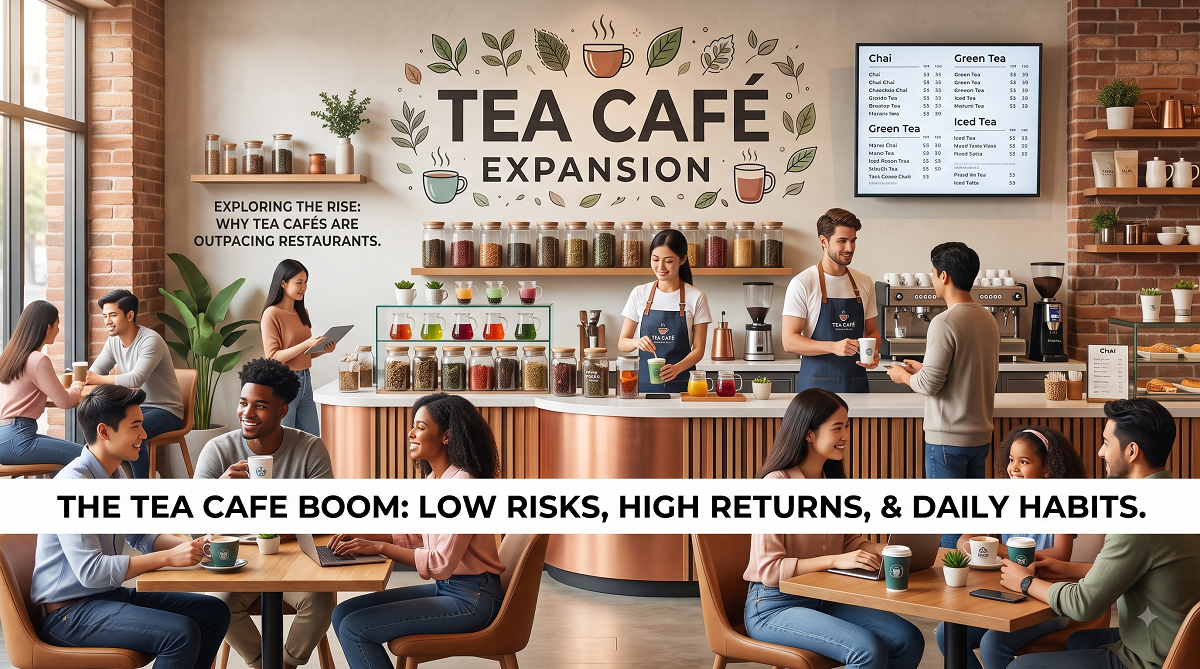
Over the past decade, a fundamental transformation has quieted the traditional dining landscape across major metropolitan hubs. While full-service restaurants grapple with skyrocketing real estate costs, volatile food prices, and unpredictable consumer footfalls, modern organized tea cafés and casual quick-service beverage hubs are opening at a record-setting pace.
Driven by shifting urban habits, high-yield financial structures, and low operational barriers, the organized tea café sector in India has grown at a Compound Annual Growth Rate (CAGR) of ~24–25%, transforming from an informal roadside ritual into a highly structured, venture-backed, and franchise-driven retail phenomenon.
The Macro Shifts Behind the Beverage Revolution
To understand why tea outlets are outpacing conventional dining establishments, one must look closely at urban demographic trends and consumer psychology:
-
The Shift to “Third Place” Socializing: Urban professionals, freelancers, and students actively seek accessible, welcoming spaces between the home (first place) and the workplace (second place). While formal dining rooms demand longer commitments and higher spend thresholds, tea cafés fulfill the need for quick, budget-friendly social interactions.
-
Frequency Over Occasion: Dining at a full-service restaurant remains primarily an occasion-driven event (weekends, family dinners, celebrations). In contrast, tea consumption is a deeply ingrained daily habit. A typical consumer might visit a restaurant once or twice a month, but frequents a tea café multiple times a week—or even multiple times a day.
-
The DEMO Shift (Demographics & Energy): With over 60% of tea café patrons falling into the 18–35 age demographic, younger consumers prefer casual, aesthetic environments offering customizable beverages, quick bites (like samosas, Maggi, or bun maska), and high-speed Wi-Fi.
1. Minimal Capital Expenditure & Optimized Footprints
The primary hurdle in scaling a traditional restaurant is the high initial capital investment (CapEx). Setting up a mid-to-large full-service restaurant typically requires 1,500 to 3,500+ sq. ft. of prime real estate, complete with complex HVAC systems, specialized commercial grease traps, heavy kitchen equipment, and extensive dining room furniture.
In stark contrast, tea cafés operate on lean spatial and infrastructural profiles:
-
Kiosk / Express Outlets: 100 to 200 sq. ft. (ideal for tech parks, metro stations, and transit hubs).
-
Lounge / Dine-in Formats: 300 to 500 sq. ft. (tailored for high-street markets and suburban retail centers).
By reducing space requirements by up to 80%, operators dramatically lower upfront fit-out expenses, initial security deposits, and recurring lease costs. This drastically lowers the financial risk for individual entrepreneurs and multi-unit franchisees alike.
2. Industry-Leading Gross Margins and Rapid ROI
Beverage-centric business models inherently command superior unit economics compared to food-heavy restaurant concepts. Raw ingredient costs for tea leaves, milk, spices, and liquid bases remain exceptionally low relative to their final retail price.
-
Gross Margins: Traditional full-service restaurants typically operate on gross margins of 40%–50% after accounting for expensive proteins, fresh produce spoilage, and intricate plating. Modern tea cafés frequently achieve 70% to 80% gross margins on core beverage offerings.
-
Payback Period (ROI): Because of low CapEx and strong daily cash flow, well-managed tea franchises often achieve full capital recovery within 6 to 12 months. Conventional dining establishments generally require 24 to 36 months just to reach breakeven.
3. Sustained Daily Footfall and High Table Turnover
Full-service dining places heavy operational reliance on concentrated peak windows—primarily lunch (1:00 PM – 3:00 PM) and dinner (8:00 PM – 10:30 PM). During off-peak hours, expensive dining rooms sit largely empty while overhead costs continue to accrue.
Tea outlets operate on a continuous revenue curve across the day:
-
Morning Peak (7:30 AM – 11:00 AM): Commuters, corporate employees, and morning walkers grabbing daily chai and breakfast items.
-
Midday Transition (12:00 PM – 2:30 PM): Quick lunch combos, coolers, and light snacks.
-
Evening Peak (4:00 PM – 8:30 PM): Post-work gatherings, casual business meetings, and youth socializing.
Furthermore, order preparation times in a tea café average under 2 to 3 minutes, ensuring fast checkout, minimal customer drop-off, and high order throughput during rush hours.
4. De-risked Kitchen Operations & Standardized SOPs
The single largest operational vulnerability for traditional restaurants is reliance on highly skilled labor—such as executive chefs and specialized cooks. Staff attrition in full-service kitchens can immediately compromise food quality, alter consistency, and lead to negative customer reviews.
Modern tea café systems mitigate this risk through strict operational standardization:
-
Pre-portioned Blends & Premixes: Signature recipes are packaged centrally, guaranteeing identical taste across 5 or 500 outlets without requiring culinary expertise on-site.
-
Short Training Cycles: Counter staff and operators can be fully onboarded via Standard Operating Procedures (SOPs) within 3 to 5 days.
-
Minimal Staffing Requirements: Most kiosk and lounge setups operate smoothly with just 2 to 4 general staff members per shift, sharply curbing monthly payroll liabilities.
5. Scalability via Plug-and-Play Franchise Networks
The explosive growth of the tea café segment is further accelerated by turnkey franchise frameworks that provide end-to-end support to first-time investors. Contemporary franchisors handle site selection, interior design, POS terminal setup, supply chain logistics, and integration with online delivery aggregators like Swiggy and Zomato.
For example, regional and national brands like Tea Adda’s Bengaluru Franchise Program offer flexible investment models—ranging from express outlets to corporate corporate setups—allowing investors to tap into high-margin beverage retailing without needing prior F&B experience.
Comparative Analysis: Tea Café vs. Traditional Restaurant
| Feature / Metric | Modern Tea Café | Traditional Restaurant |
| Space Required | 100 – 500 sq. ft. | 1,500 – 3,500+ sq. ft. |
| Average Setup Investment | ₹4 Lakhs – ₹10 Lakhs | ₹30 Lakhs – ₹1 Crore+ |
| Gross Profit Margin | 70% – 80% | 40% – 50% |
| Staffing Needs | 2 – 4 cross-trained staff | 10 – 25+ (Chefs, stewards, managers) |
| Waste & Spoilage Risk | Very Low (dry goods, stable shelf-life) | High (perishable raw ingredients) |
| Average ROI Timeline | 6 – 12 Months | 24 – 36 Months |
| Daily Footfall Curve | Continuous (Morning to Late Evening) | Concentrated (Lunch & Dinner peaks) |
| Operational Complexity | Low (SOP-driven, central supply) | High (Recipe dependence, complex prep) |
Key Takeaway
The modern tea café is not merely a passing retail trend; it represents a fundamental realignment of food and beverage economics. By solving the core vulnerabilities of traditional dining—high real estate costs, heavy labor reliance, low margins, and localized operational friction—tea cafés have established a highly resilient, repeatable, and profitable template for rapid retail expansion.
